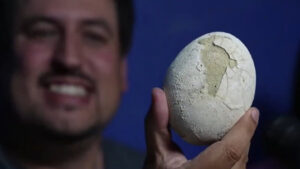
Scientists uncover perfectly preserved dinosaur egg in Argentina

Paleontologists in Argentina discovered a 70-million-year-old dinosaur egg preserved in pristine condition in Rio Negro province. Scientists from the Bernardo Rivadavia Argentine Museum of Natural Sciences found an entire nest containing the fossil and believe it belonged to Bonapartenykus, a small carnivorous theropod related to modern birds.
Researchers will use CT scans to determine whether embryonic remains are present within the shell. The egg resembles those of contemporary avian species with thin, fragile walls that rarely survive fossilization. Vertebrate paleontologist Gonzalo Leonel Munoz said any embryo would reveal developmental stages and evolutionary connections between dinosaurs and birds.
The team documented their work through social media posts showing the intact specimen. Carnivorous dinosaur eggs appear less frequently than herbivore fossils because meat-eating species produced fewer offspring and their eggs broke down more easily over geological time periods.
Museum specialists will transport the nest to Buenos Aires for detailed examination. The discovery offers potential insights into theropod reproductive behavior and growth patterns from the late Cretaceous period.