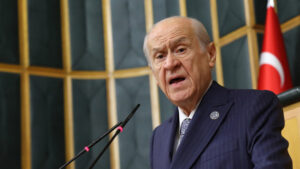
Bahceli proposes Türkiye-Russia-China alliance shift

In September, Turkish nationalism took a significant turn as Devlet Bahceli, leader of the Nationalist Movement Party (MHP), proposed a strategic alliance between Türkiye, Russia, and China to counter what he called the “US-Israel evil coalition.” This move signals a departure from Türkiye’s traditional alignment with the West and NATO, marking a potential break from its Atlanticist past.
Bahceli’s comments reflect a growing sentiment within parts of Türkiye’s leadership to seek greater strategic autonomy, positioning the country as a key player in a multipolar world. His proposal, which frames Türkiye as a leader rather than a follower in global politics, has been met with mixed reactions at home, with right-wing groups seeing it as revolutionary and leftists viewing it as part of a broader anti-Western shift.
President Erdogan, while cautious, suggested openness to the idea, signaling it could be used as leverage to pressure the US and EU. This marks a shift in Turkey’s foreign policy, aiming to strengthen ties with Russia and China while distancing from the West. Bahceli’s call for a new Eurasian-focused strategy reflects a broader desire within Türkiye to assert itself as an independent power center, free from Western influence.
The shift reflects broader geopolitical changes, where Türkiye seeks to navigate economic challenges, regional instability, and global shifts away from unipolarity. With growing discontent over Western policies, Türkiye is looking to build stronger ties with Russia and China to secure its autonomy and future role in global affairs.