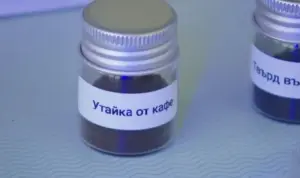
Bulgarian scientists turn coffee grounds into battery material

Bulgarian Academy of Sciences researchers have converted discarded coffee grounds into carbon materials suitable for sodium-ion battery production, addressing energy storage needs while reducing waste. Scientists at the Institute of General and Inorganic Chemistry heat the spent grounds beyond 1,000 degrees Celsius to create carbon for battery electrodes, then process the material through drying and argon furnace treatment before application to metal foil.
Director Radostina Stoyanova indicated that the technology enables renewable energy storage from solar and wind installations as Bulgaria expands green power generation. Associate Professor Maria Kalupsazova noted that sodium-ion batteries allow the use of less expensive foil components compared with alternative designs.
The development positions Bulgaria to manufacture batteries domestically without importing raw materials from foreign suppliers, according to Stoyanova, who emphasized that the nation possesses the necessary resources for independent production capability in the growing energy storage sector.