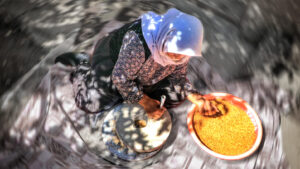
In Sarnijmar, Kurdish women keep ancient grain-grinding tradition alive

In the courtyard of a village in Eastern Kurdistan, a timeless scene unfolds. Four women and a man, dressed in traditional Kurdish attire, sit in a semi-circle, their attention focused on an ancient hand-mill, the Destar. As one woman turns the heavy stone, the rhythmic grinding sound fills the air, echoing a history that spans millennia.
This simple act is far more than a chore; it is a communal ritual, turning grains into sustenance and weaving together the stories of the Kurdish people. The Destar, crafted from two heavy stones, has long been a symbol of resilience, especially in times of hardship and scarcity.
Wheat, revered for its sacred significance, symbolizes life and abundance. Grinding it is a physical act of gratitude and reverence, a practice passed down through generations of women who have kept their traditions alive. The sound of the Destar is not just the noise of work; it is the heartbeat of a community, where social bonds are strengthened and knowledge is shared.
Despite periods of hardship, such as famines and economic exploitation, the act of grinding grain remains a powerful assertion of independence. For the women of Sarnijmar, the Destar is a testament to their vital role in preserving culture, nurturing family, and ensuring survival, no matter the challenges they face.